
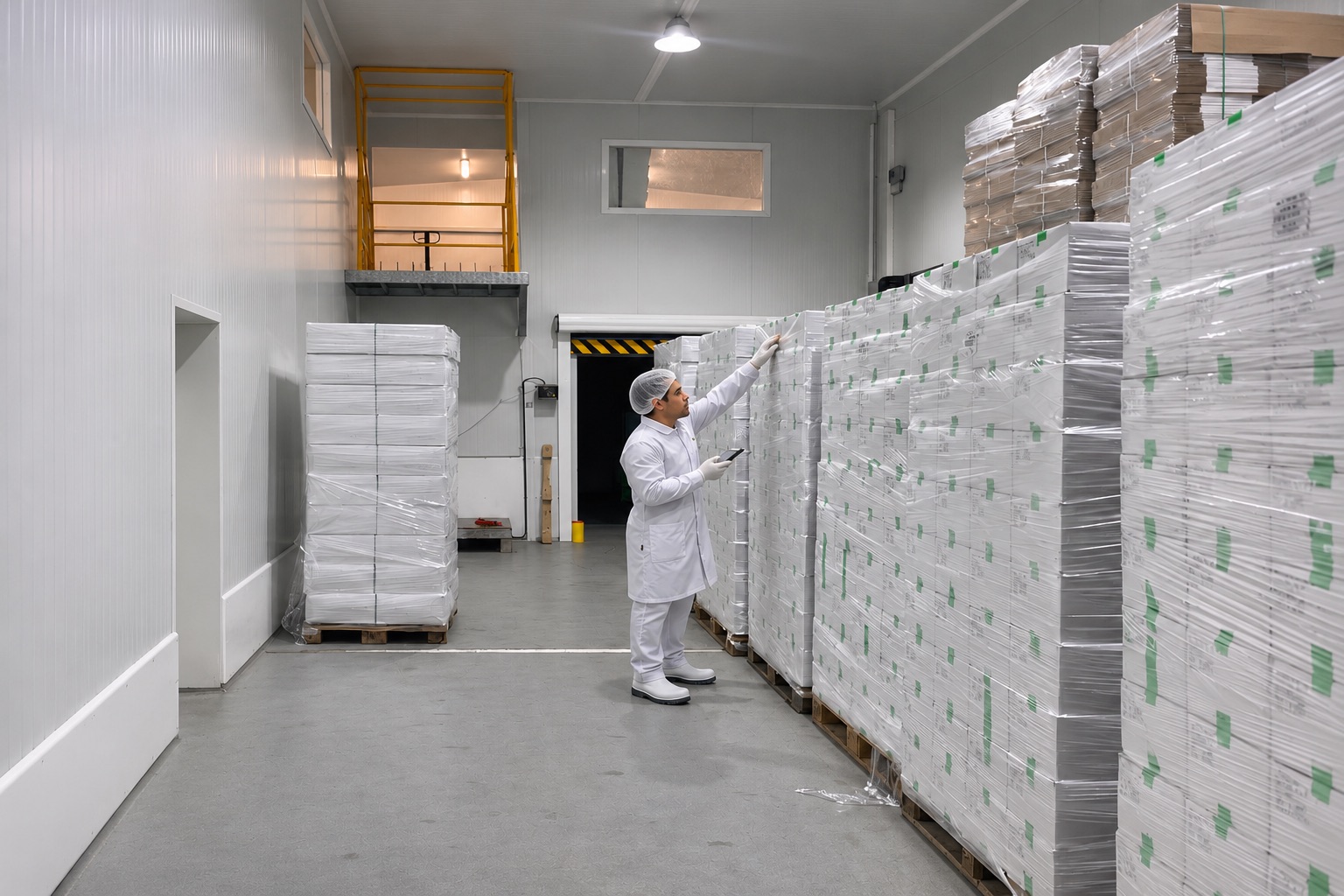
Receipt and organisation of goods
To assess an arrival, we need to know the food, its storage condition, quantity, product references and batches. How it arrives also matters: boxes, pallets or other groupings, and which documentation accompanies the consignment. Receipt includes identification and temperature checks according to the defined operation. Before placing the product in storage, its owner, separation of product references and storage instructions must be clear. If the goods subsequently require handling, packaging or a format change, communicate this in the enquiry so we can assess the complete route. We do not assume a specific capacity, temperature or storage period without reviewing the project’s particular conditions and the availability required to organise it.
Order preparation with defined product references and batches
A preparation order must specify which goods leave, in what quantity and grouped in what way. We can assess boxing, reorganisation, identification, palletising, stretch-wrapping and strapping tasks according to the requested dispatch format. When an order combines several product references, we need instructions that distinguish them and maintain the link to their batches. The documentation and presentation the next operator must receive are also defined. If your customer requires a specific box or pallet configuration, provide their specifications before work begins. The aim is to prepare a dispatch consistent with the agreed order and product traceability, avoiding outstanding decisions on quantities, materials or destination during preparation.
Details for coordinating arrivals, storage and departures
Share a forecast of kilograms, boxes or pallets, product references and batches, together with the product’s storage condition. Explain the expected storage period, frequency of movements and tasks you need before dispatch. Provide photos of current groupings, order instructions and identification requirements. It is also important to know who supplies boxes and other materials and who organises incoming and outgoing transport. Preparation for dispatch does not in itself imply a transport service. With these details, we can assess the operation’s scope, receipt conditions and coordination needs for each movement of goods.
Arrivals and departures with information prepared in advance
Coordination improves when goods information arrives before the transport. An expected arrival must identify the owner, product, product references, batches and quantities, as well as the expected date and grouping format. If the consignment needs subsequent tasks, attach the instruction so storage placement and the route can be assessed. For dispatch, the order must specify the operational recipient, quantities and required presentation. Distinguish a planned movement from a confirmed one and communicate changes so the current instruction can be identified. This organisation prevents a general forecast being interpreted as a preparation order and allows review of the documentation needed to link what was received, stored and prepared for each dispatch.
Combining storage with format changes or partial preparation
Not all goods from an arrival necessarily need to follow the same route. We can assess keeping part in storage while another part is prepared to a specific order, provided quantities, product references and batches are identified. If reboxing, bagging or labelling is needed before departure, these tasks must appear in the project with their materials and instructions. The enquiry must identify differences between the presentation received and the one to be delivered. The expected frequency of movements and any particular buyer requirements are also useful. The proposal’s scope is defined using this information, without assuming storage capacity, storage periods or dispatch conditions that have not yet been reviewed for the requested operation.
Details needed to assess your operation
- Product, condition and batch of the goods.
- Approximate volume and frequency of the work.
- Incoming format and finished presentation.
- Materials supplied and labelling requirements.
- Expected date and delivery conditions.
Frequently asked questions
Can we combine cold storage with contract processing?
We can assess an operation linking receipt and storage with handling, processing, packaging or reboxing. We need to know the complete route, expected timings and finished presentation. Each stage must be expressly included in the proposal, together with product conditions and the materials required for the work.
Does the service include transport?
Transport must not be understood as included simply because a dispatch is prepared. The enquiry must indicate who organises arrival and collection of the goods, as well as documentation and presentation requirements. The proposal defines the tasks undertaken by AES and the necessary coordination with transport operators.
What information should a preparation order contain?
Include the product reference, batch, quantity, box or pallet format, identification and dispatch destination. Any particular customer instructions must accompany the order. Also indicate which groupings cannot be mixed and the materials needed. This information allows preparation to be reviewed before organising the movement of goods.
Can just part of a stored consignment be prepared?
Partial preparation can be assessed if the kilograms, boxes or units, product references and batches to be dispatched are identified. The order must also indicate how the order is presented and which goods remain in storage. If dispatch requires handling or a format change, describe those tasks. Conditions and organisation are agreed before confirming the movement.
What details should be sent before the lorry arrives?
Provide the identity of the company owning the goods, the product, its storage condition, product references, batches and expected quantities. Include how the goods are grouped and which documents accompany them. We also need to know the subsequent work and expected arrival date. Receipt is organised according to agreed conditions; an arrival forecast does not replace confirmation of the operation.
Services that can complete the job
YOUR NEXT OPERATION
What does your product need?
Tell us the service, volume and finished format. We will work with you to assess how to organise the job.